
Three, five, or even twenty years of cohabitation will not grant you the legal status of a married person.
Common-law unions are a reality experienced in all regions of Cameroon, by people of both sexes, and at almost all ages. A common-law union creates in principle no obligation between partners, and the consequences often observed and brought to the attention of MINPROFF services reveal the distress of abandoned women with children born from these unions.
Brief reminder of the legal framework of common-law unions in Cameroon
Legally, the law in force in Cameroon does not recognize common-law unions. Indeed, cohabitation, regardless of its duration and stability, produces no effect on the legal status of these persons or their property. Because it is not mentioned in civil status registers, it confers in particular no right to a name or nationality. Furthermore, unlike marriage, it does not carry a presumption of paternity for children born from the relationship, as the concubine is not subject to the same obligations as a married woman.
However, Article 340, paragraph 5 of the Civil Code applicable in Cameroon makes cohabitation a ground for opening an action to establish natural paternity: “In the case where the alleged father and the mother have lived in a state of notorious cohabitation during the legal period of conception.”
In all cases, concubines escape the duties of marriage. Moreover, if they cohabit, it is of their own free will. They owe each other in law neither fidelity, nor assistance, nor material support. No inheritance rights arise from their relationship either. If resources or property have been pooled, these will be shared upon the breakup of the cohabitation according to the rules of the de facto company.
Because there is no legal bond between concubines, the breakup can occur at any time either by mutual consent, contentiously, or by the will of one of the partners. As soon as the agreement disappears, the union ceases without any procedure similar to divorce being necessary.
However, alimony may be claimed on behalf of a child born from this union. Also, even if the parents live separately, they continue to exercise parental authority over their child(ren). The concubine cannot therefore oppose, except on serious grounds, the exercise of a right of access.
Actions of the Ministry of Women’s Empowerment and the Family
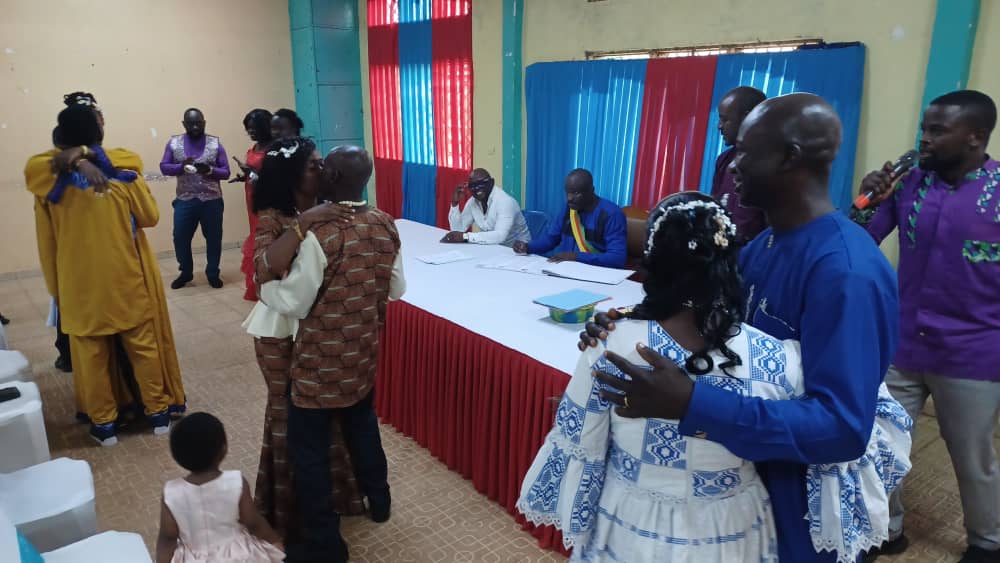
In view of the legal framework reserved for common-law unions and the dramas experienced by women, the Ministry of Women’s Empowerment and the Family, through the actions of the National Observatory of the Family and the Women’s and Family Promotion Centers (CPFF), encourages partners to regularize their unions through collective marriage ceremonies.
Thus, since the beginning of the implementation of this action, more than 35,000 marriages have been celebrated collectively with the support of the Ministry of Women’s Empowerment and the Family. It should be noted that this activity has been opened to other partners and is implemented by them under the coordination of MINPROFF.
Furthermore, partners themselves, without having to wait for MINPROFF’s support, are encouraged to regularize their unions before civil status centers and the competent courts.
The process of regularizing common-law unions through collective marriage celebration integrates collaboration with civil status centers and decentralized services of MINPROFF. It begins with the registration of potential partners in the registers of district delegations for women’s empowerment and the family.
It remains clear that couples in common-law unions for whom the common-law union is a transitional situation believe they can fulfill their duties to regularize this situation as soon as possible.